Foundations Group Course
The course for anyone who knows what they want to say — but hasn't yet found the camera settings to say it.
Most people who pick up a camera already have a sense of what they want to photograph. What holds them back isn't imagination or vision — it's the gap between what they see and what the camera produces. Photography Foundations is designed to close that gap.
Over three two-hour sessions, you'll move from relying on Auto mode to making confident, conscious decisions about every image you take. Not because you've memorised a set of rules, but because you understand what your camera is actually doing — and why the choices you make matter.
This is not a course about technical perfection. It's a course about intentional photography.
Foundations Group Course Details
-
Attention → Intention → Creation → Reflection
This is the AICR Method — the framework that runs through every session and through every serious photographer's practice, whether they name it or not. You'll learn to bring genuine attention to what's in front of you before you raise the camera. To form a clear intention about what the image should do before you press the shutter. To create the image rather than simply take it. And to reflect honestly on what worked, what didn't, and why — using that gap not as judgment but as information.
-
Taking Control:
How cameras interpret light, and why Auto mode is making decisions that should be yours. You'll leave this session shooting confidently in Manual mode, understanding aperture, shutter speed, and ISO not as abstract settings but as creative tools.
-
Seeing Photographs:
Composition is not a set of rules — it's a way of prioritising what matters in a frame. You'll learn to identify what a photograph is actually about, remove what doesn't serve it, and place your subject with intention rather than habit.
-
Light, Colour and Creative Control Light is the medium. This session develops your ability to read it, work with it, and use it to shape the mood and meaning of your images. We'll also cover white balance and the creative use of exposure beyond mere correctness.
-
Maximum Of Four:
Three sessions of two hours each, in-person in and around Cambridge. The group is intentionally small — four people is the upper limit, not the target. That means genuine individual attention in every session, space to ask questions without an audience, and the added dimension of learning alongside a small number of people at a similar stage.
-
Photography Foundations is for anyone who:
Owns a camera with manual or semi-manual controls
Too often finds themselves relying on Auto mode and wanting to understand why
Has a sense of what they want to photograph but not yet how
Feels put off by the technical and sometimes macho culture of photography and wants a different kind of learning environment
You don't need prior experience. You don't need expensive equipment. You do need curiosity and a willingness to look at the world carefully.
Not sure if this is the right level for you? Book a Finding Focus session.
Three sessions of two hours each, in-person in and around Cambridge. £180 — £130 after a Finding Focus session
*Group sessions run once minimum numbers are confirmed. If none of your preferred group sessions are currently available to book, you can register your interest here — and in the meantime, why not make the most of the wait? A Finding Focus Session is the ideal starting point — a one-hour one-to-one conversation about your photography at £50, fully redeemable against your group course booking. You'll arrive at the first session knowing exactly what you want to work on: Finding Focus One-to-One
See all available dates on the Training Calendar
About The Sessions
-
I work with photographers at all levels — complete beginners building foundations, experienced amateurs wanting to move beyond competence, and working practitioners looking to develop a more intentional and personal practice.
Sessions are practical and hands-on. We work from where you are, not from a fixed syllabus. Depending on what you need, we might cover the technical fundamentals of exposure, light and composition; how to work with and direct people in front of a camera; developing and articulating your own photographic vision; or the editorial and post-production decisions that shape a finished image.
What I won't do is tell you what to photograph, or prescribe a single correct approach. My job is to equip you with the tools to answer those questions for yourself — and to help you trust your own answers.
All sessions are in-person, based in and around Cambridge.
-
Photography culture can be unnecessarily intimidating. The obsession with equipment specifications, mega-pixel competition, and the unspoken hierarchies of gear and genre put many people off before they've even begun — and disproportionately so for people who've been told, implicitly or explicitly, that technical subjects aren't for them.
The same culture would have you believe that you need the latest camera body, the sharpest lenses, and a significant financial investment before you can begin to make worthwhile images. You don't. What you need is a camera that gives you creative control — the ability to make conscious decisions about exposure, light, and composition. Beyond that, the rest is you.
That's not the culture here. The skills of photography are learnable by anyone with curiosity and commitment. What I'm interested in is helping you develop confidence — in your technical ability, in your creative instincts, and in your own distinctive way of seeing the world.
If you're unsure whether what you already own is enough to get started, the answer is probably yes. See our equipment guide.
-
Attention → Intention → Creation → Reflection
This is the AICR Method — the framework that runs through every session and through every serious photographer's practice, whether they name it or not.
-
You'll get the most from working with me if you're genuinely curious about photography as a practice — not just as a means of capturing moments, but as a way of making meaning. You don't need to be experienced. You don't need expensive equipment. You don't need to have spent time in photography clubs or online forums. You just need to be willing to think as well as shoot.
If that sounds like you, a Finding Focus Session is the best place to start.
-
Subject to sufficient interest, future sessions will include smartphone photography — making the most of the camera you always have with you — and analogue film photography, including home developing. If either of these interests you, register your interest via the link below and you'll be the first to hear when dates are confirmed.
Meet Your Instructor
Xander Sandwell
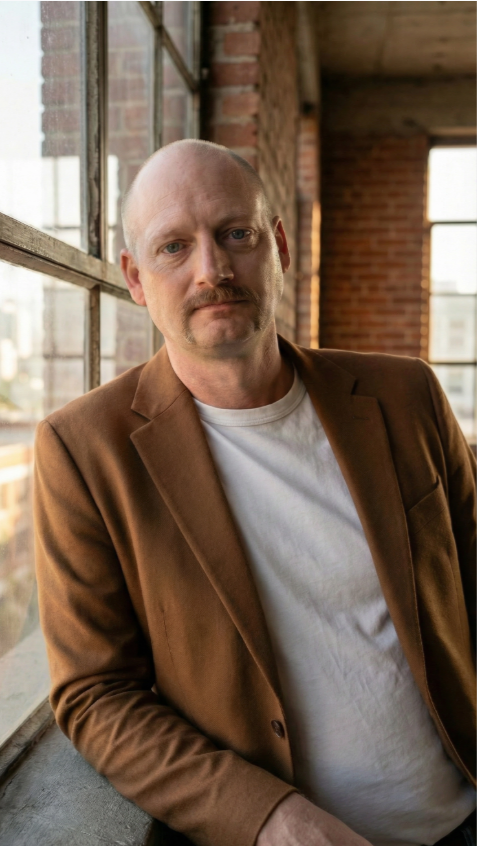
I'm Xander Sandwell, a Cambridge-based photographer and educator. My practice spans portrait, editorial and fine art photography — work exhibited at the Photographers' Gallery London, the Annenberg Center California, and the Ruskin Gallery Cambridge, and featured in Digital Photography Magazine and the Guardian. I hold a BA and MA in Photography and am currently completing a PhD by practice at the University of Gloucestershire. That academic background informs everything I do as an educator — I think carefully and seriously about what photography is, what it does, and how it works, and I bring that thinking into every session I run.